
Appearance
Invoice calculation
When an invoice is created, it automatically pulls data from the following sources:
- Timesheets: time invested in the project by employees.
- Expenses: project-linked expenses logged by employees.
To understand how this works, consider the following diagram where an invoice is created for the billing cycle 12 August to 16 September:
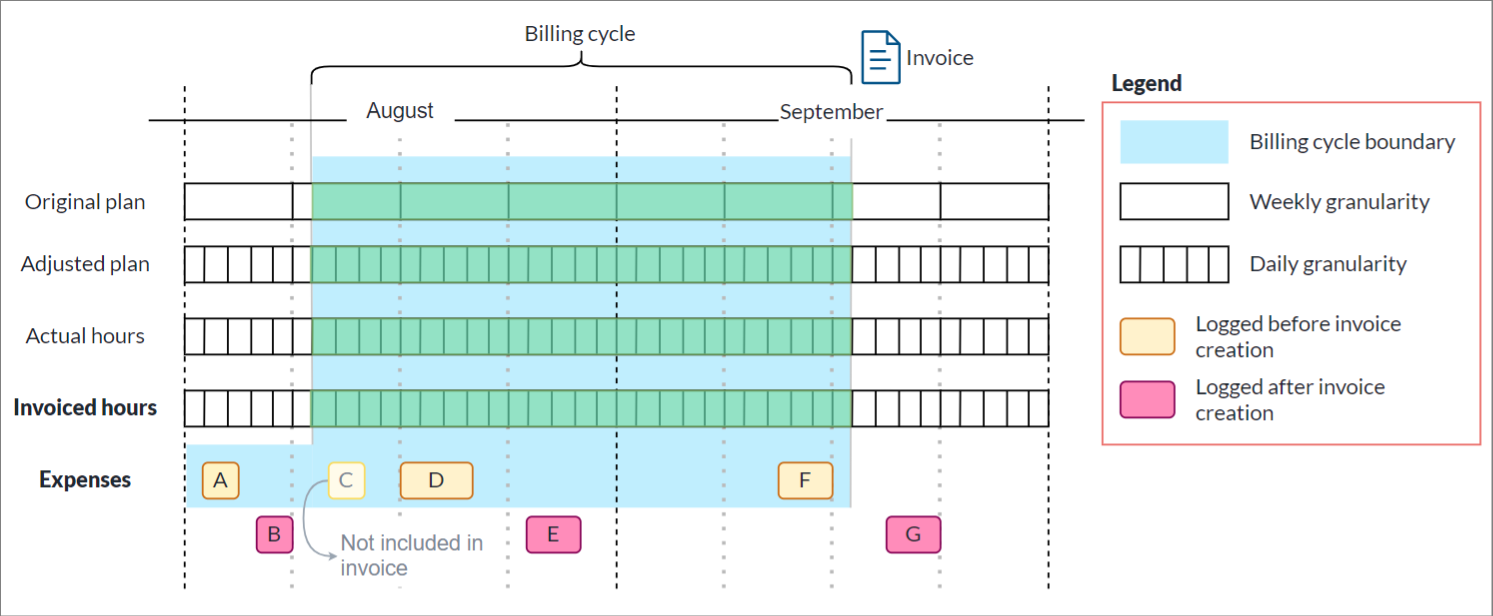
Although the original plan, adjusted, and actual hours are within the billing cycle boundary, the value of the invoice is determined by the invoiced hours and expenses. To understand how the expenses are included, consider the examples shown in the diagram:
- Logged before invoice creation: these expenses were logged by employees or contractors before the invoice was finalized.
- A: This expense was actually part of the previous billing cycle, but since it hasn't yet been included in an invoice it's pulled into this billing cycle's invoice.
- C: Although this expense falls in the billing cycle, it's not ready to be included in the invoice because it is not yet approved by the project director or excluded for some other reason.
- D and F: These expenses were logged and approved during the billing cycle and therefore form part of the invoice.
- Logged after invoice creation: these expenses were logged by employees or contractors after the invoice was finalized.
- B, E, and G: These expenses will form part of a subsequent invoice.